

This Text Is Slop - Certified
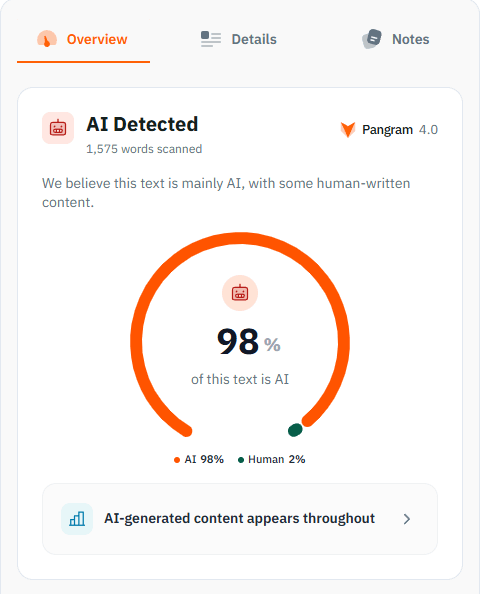
Pangram scanned the first 1,575 words of this text. Verdict: 98 percent AI. (The rest would have cost more free credits than I get in a day.)
According to half of my timeline, you can stop reading now and instead enter your e-mail into the box below:
Still here? Bad news. Statistically, you are now biased, and I can prove it.
A study with more than 27,000 people looked at exactly what that first line just did to you. Telling readers that a piece of writing had AI help made them value it less. The researchers threw every intervention they had at that penalty, and it did not go away. (Raj, Berg & Seamans, 2026.)
If you are like the average reader in that study, the label is already lowering your opinion of every sentence that follows.
Good. Let’s see if it survives the next few thousand words.
And no, the detector did not lie. More on that later. First, a crayon drawing.
Unfiltered Childlike Sovl
December 2022. Someone posts a crayon drawing of Sonic on 4chan. Blue scribbles, red shoes, motion lines, the kind of thing a kid makes on lined paper and a parent sticks on the fridge.
The thread goes soft immediately and then….
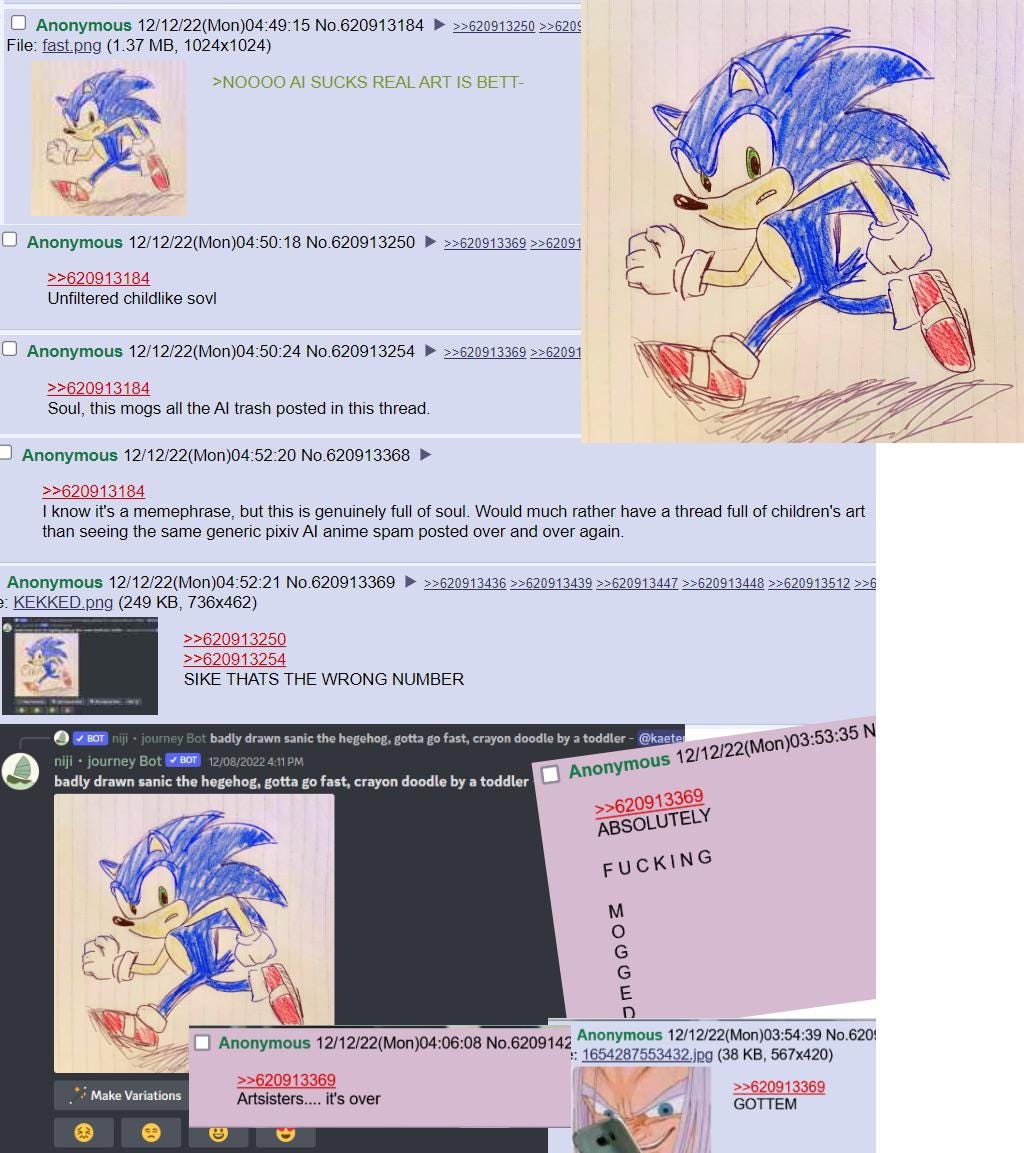
That thread is almost four years old, and back then it was a joke. In 2026 it is a lifestyle. This year a post saying “I’ve gotten so used to AI slop that now when I see bad art made by a human I think it is cute and endearing” collected 78,500 likes. Bad is cute now, as long as the birth certificate says human.
So Is This Mine?
You are already typing the reply: “lol, AI-written article about AI slop.”
Yes. That is the title. Everything I have published here was made the way this one was. I pick the fight, I bring the anger and the material, and then my agents and I ping-pong drafts until I hold something I would have wanted to read. I do not hide that. It is the first line of the article.
So is it mine?
Depends on what you mean by mine.
If “mine” means “who typed the words”, then no. Not most of them.
If “mine” means “whose work is this”, then yes, and it is not close. Without me there is no thesis, no anger, no Sonic thread, no goalpost list, no decision about which edits stay and which get thrown out. The machines delivered words. The selection, the judgment and the accountability are mine. And when this post gets torn apart in the comments, it is my name under it. Not Claude’s. Not Codie’s.
Call it an AI excuse if you like. It is how authorship of anything big has always worked.
A film director does not operate the camera, hold the boom or build the set. People say a film gets written three times, and the last time is in the edit.
Rembrandt ran a workshop full of students, and art historians have spent decades sorting out which “Rembrandts” he painted himself.
Celebrity memoirs routinely come with ghostwriters, and nobody calls them slop.
People argue about those credits all the time. But nobody thinks typing every word is the only way to make a work yours. A work belongs to the person whose judgment shaped it and who stands behind it.
The goal is that every sentence says what I mean, the way I would say it, and that I would have wanted to read the result. If it does, it is mine, whoever typed it. If it does not, no amount of typing it myself would have fixed that.
Hold that thought. It is the third question of the only test I trust, and at the end we will run that test on this text.
Slop Used To Mean Something
Let me be fair to the word first, because the word did nothing wrong.
Simon Willison popularized “slop” in May 2024 for unwanted AI content. AI was always in the definition. So were two conditions: nobody asked for it, and nobody checked it. It was a good word. It caught on so well that Merriam-Webster made “slop” its 2025 word of the year, and Macquarie Dictionary picked “AI slop”.
Real slop looks like this. In 2024, researchers Renee DiResta and Josh Goldstein tracked 120 Facebook pages that each posted at least 50 AI images, Shrimp Jesus included. Together the pages pulled in hundreds of millions of engagements. Spammers, scammers and growth hackers, farming clicks from people who often did not even notice the images were fake. Add SEO content mills turning every recipe into 4,000 words of invented grandma memories, fake product reviews, and spam books on Amazon whose author bio came from the same model as the contents.
That is slop. I hate it too. Everyone with a working brain hates it.
Notice what made it slop, though. It was the process, not the model. Nobody wanted it, nobody checked it, nobody stood behind it, and it existed only to harvest a click from someone too tired to scroll past.
Slop was a word about process: no check, no consent, zero care for whether the thing is true, useful, or wanted.
Then something happened to it.
Then It Became a Birth Certificate
Somewhere between 2024 and now, the two conditions fell off. “A machine was involved” became the whole definition.
Same word, different job.
The old job: describe the thing.
The new job: tell you which thing you are allowed to stop reading.
This one comes with receipts. It is one of the most replicated effects in the AI-and-people literature.
Show people AI-made paintings, tell half of them a human painted them, and the “human” half likes them more and rates them as more beautiful, more profound, and worth more. Same paintings. (Bellaiche et al., 2023.)
Do it with news headlines and it gets worse. In a study with almost 5,000 people, an “AI-generated” label made headlines look less accurate. Even the true ones. Even the ones a human wrote. The label alone did about a third of the damage of an actual “false” label, because people assume the whole thing was automated. (Altay & Gilardi, 2024.)
A label about who made a headline changed whether people believe a true fact.
Do it with poetry and it gets funny. Ordinary readers trying to tell AI poems from famous human poems scored 46.6 percent. Below a coin flip. They rated the AI poems as more human than the human ones. And on 13 of 14 qualities, poems scored lower when readers were told they were AI and higher when they actually were AI. (Porter & Machery, 2024.)
That is the Sonic thread with a methods section.
And the accusations? A preprint that went through 25 million Hacker News and Reddit comments from 2023 to 2026 found that the pejorative share of “AI” accusations rose more than tenfold. By 2026, “slop” made up 94 percent of the pejorative labels. The punchline: in a matched Reddit sample, most of the writing features that actually separate AI text from human text did not predict who got accused. The authors call it “social gatekeeping of perceived authenticity”. (arXiv 2606.12073, preprint.)
So when I see “slop” today, I sort it into four species:
Descriptive slop. “This page is 400 AI-generated listicles about pickleball, nobody edited them, half the facts are invented.” Correct. Carry on. To be fair, when researchers had experts annotate AI text, the “slop” calls tracked real problems with coherence and relevance. Inside AI output, the word still discriminates.
Burden slop. “You dumped this on me and now I have to check it.” Also legitimate, and I will come back to it, because this is the one real argument the slop crowd has.
Provenance slop. “AI made this, therefore it is bad.” No reading required. The verdict arrives before the content does. This is the Sonic thread.
Defensive slop. The output is good, or correct, or both, and that is exactly the problem. It threatens a job, a status, a sense of what humans are for. Calling it slop is how you get to not engage with it. You do not have to refute a proof if you can call it slop. You do not have to update your career plan if the thing that just did your job is slop.
The first two are judgments.
The third is a prejudice.
The fourth is a coping mechanism wearing a judgment’s clothes.
And the slop I am arguing with is species three and four, borrowing the credibility of species one and two.
The smart version of the argument deserves an answer. When the flood is unchecked AI text, “AI made this” is a decent first guess that checking will be expensive. Fine. A first guess. But look at what the headline study did next: tell readers the AI drafted from a journalist’s sources or polished a journalist’s text, and no detectable penalty showed up. Readers heard “AI-generated” and filled in “fully automated”. The label was never measuring the AI. It smuggled in a workflow.
Hundreds of Proofs of Slop
Which brings us to October 6.
OpenAI released a pile of mathematics. Hundreds of results on open problems, some of them open for decades. And a large part of it came with formal proofs in Lean, a language where a machine checks every inference. According to OpenAI’s own researcher, about 42 percent of the headline results were formalized, and three were withdrawn after people looked closer.
That is not perfect. I will get to the fair complaints. But in any other universe this is still the science story of the year. Champagne. Front pages. Mathematicians fighting over who gets to work on the next one.
In our universe, a good part of math Twitter called it slop.
One post I saw: it writes like shit, it communicates poorly, it gets the Lean solver to be happy but basically churns unreadable slop.
Read that again.
“It gets the Lean solver to be happy.”
That is where the proof is verified. That is the part where a machine that does not care about anyone’s feelings checked every step and said: yes, this is true. And it is the throwaway clause before the word “but”.
I replied that I remember software developers saying exactly this twelve months ago. It writes ugly code. It does not follow our conventions. Sure, the tests pass, but. That “but” aged like milk.
Funny thing is, the same post says “Complaining that the AI solved math is dumb.” Its complaint is taste and review cost. That is burden slop, and it is real. A checked result does not pay the reader’s review bill. But an unpaid review bill does not make the theorem false either.
In the threads we went through, almost nobody who used the word “slop” disputed a single theorem. Not one of them named a result and showed it was wrong. The complaints were about exposition, about the volume landing on human reviewers, about missing prompts and process notes. Some of those complaints are real. Even Lior Pachter, who is no OpenAI cheerleader, said the write-ups are “definitely not an exemplar of fine math exposition”, and in another post said calling hundreds of solutions with Lean formalizations “slop” is “unserious”.
He is right twice. Bad exposition is a real cost. It is also not what the word claims.
And if understanding is the paramount goal of math, mathematicians should be happy. OpenAI just gifted them decades’ worth of stuff to extract understanding from. So why complain?
Look at the goalposts:
AI will never be able to code.
AI will never solve olympiad problems.
AI will never write real mathematical proofs.
AI will never contribute anything original to research.
And the new one, which dropped while I was writing this: AI will never come up with new research questions.
At this rate, the goalposts will achieve AGI before the skeptics do.
Every one of those was stated with total confidence. Every one of those is dead or dying. And the word that keeps the retreat orderly is “slop”. You do not have to admit the goalpost moved if you can call whatever is standing on the old spot slop.
When AI came for artists and developers, we were told to adapt. Now that it is proofs instead of code, it is suddenly a violation of the sacred norms of scientific research. If you told us to adapt, you do not get to discover the sanctity of human labor the minute it is your labor.
Welcome to the club. Onboarding is fully automated.
Someone on X summed it up better than I can, with a parody of Niemöller’s “First they came for...”. I did not bookmark it and now I regret it, so this is from memory:
First AI came for the artists, and I did not speak out, because I was not an artist.
Then AI came for the developers, and I did not speak out, because I was not a developer.
Then AI came for the mathematicians.
And when it finally came for the philosophers, they just asked: “What took you so long?”
Math is the purest case for a reason. With art, you can argue taste. With code, you can argue maintainability. With a Lean-checked proof you cannot argue correctness. The verifier is the most hostile reviewer in the history of science. It has no friends at the conference. It does not care about your h-index. It checked.
You can argue three things: whether the formal statement says what the problem asked, whether its assumptions hold, and whether Lean checked the headline result or just a supporting lemma. Real checks, somebody has to do them, and they are exactly the complaints the slop crowd did not make. They did not say “your statement is misformalized”. They said “slop”.
If the one kind of output that comes with a machine-checked certificate of truth still gets called slop, then the word has nothing to do with truth anymore.
Translation: “slop” is a verdict about the prover, not the proof.
The Detector Was Right
Back to the stamp at the top of this article.
I published “The Skull Had Walls” on the same day I started this one, and Substack’s AI check, Pangram, gave it 100 percent AI. Honestly? I would have said 90. And I have to give the machine its due. It was probably right, both times. Independent testing found Pangram to be the only commercial detector with near-zero false positives on longer texts, and the only one that met a strict false-positive cap. (Jabarian & Imas, 2025.) The older generation of detectors was a lot worse. A 2023 study showed they flagged non-native English writers at absurd rates. (Liang et al., 2023.) This one works, at least on the texts those researchers tested. They compared human writing with model writing, not a collaboration like this one.
So the detector did not lie about the birth certificate.
The problem is what everyone does with the birth certificate.
The detector cannot tell you that the arguments are mine, that the anger is mine, or that the lobotomy numbers in that essay were checked against Britannica the same night. It tells you who held the pen. And then a reader, a platform, a teacher or an editor turns “who held the pen” into “is this any good”.
The same night, out of curiosity, I ran that draft through a so-called humanizer: a 12B model fine-tuned to rewrite AI text so that detectors call it human. Its makers say 95 percent of its test rewrites pass Originality.ai as human. On my essay, it turned my closing line “Watch who gets root” into “Pay attention to who gets root”. It changed “more than 50,000 lobotomies” into “50,000”. It turned “the severely mentally ill” into “dangerously mentally ill”. It broke paragraphs, broke grammar, and gave me “The skull was walled. Now it’s software that’s walled.”
That is what “sounds human” buys you.
So we built a machine that correctly says who wrote the text, and a market of machines that make the text worse until detectors stop noticing. Katie Notopoulos declared typomaxxing the new meta: grammatical errors, random extra spaces, at least one “teh” per email, “or else people will think you’re an AI-using workslop slinger and ignore you”. LinkedIn added a “Seems like AI slop” button and people clicked it more than a million times.
None of this protects quality. All of it is about the birth certificate.
My last essay was about rules the governed cannot read. A slop flag is one of those. Whether it comes from a detector, a button or a mob, you cannot see why it fired, you cannot appeal it, and once it fires, the thing is guilty before anyone names a defect.
Human Slop Had a Long Head Start
Now the part the slop crowd never wants to hear.
Humans produce slop. Industrially. We were doing it long before any model shipped.
In 2015 the Open Science Collaboration tried to replicate 100 published psychology studies. About a third of the replications came out significant. Ten years earlier, John Ioannidis had published a paper simply titled “Why Most Published Research Findings Are False”. Humans wrote those studies, humans peer-reviewed them, humans cited them for years. Nobody calls the replication crisis “human slop”. Not every failed replication is garbage. But human authorship and human peer review did not guarantee reproducible results. The birth certificate was immaculate. The evidence still needed checking.
Every corporate slide deck you sat through. Every “per my last email”. Every 80-page strategy document that could have been a sentence. Every Reddit expert explaining a paper they did not read. Every LinkedIn post that starts with “I was let go today. Here’s what it taught me about B2B sales.”
But here is where I owe the other side something. Under all the noise there is one real argument, and it is burden slop.
AI makes producing things cheap and leaves checking them just as expensive. That moves the cost from the person who generated something to the person who has to read it. Researchers from BetterUp and Stanford gave it a name in 2025: “workslop”, content that looks like good work but does not move the work forward. In their survey of more than 1,100 US workers, those who had met workslop said it made up about 15 percent of what they received, and each case cost them nearly two hours. In open source, a study of 294 projects found that pull requests went up in 2025 while merge rates went down. Maintainers drown, and one-time contributors pay for it: their merge rates ran about 18 percent below their earlier trend.
That is real. I believe it. I have received the two-page email that should have been two lines.
But read those findings carefully. The slop in workslop is not the model. It is hitting send on output nobody checked. Same model, careful user: useful work. Same model, careless user: slop. The variable is the human process.
Shopify’s Tobi Lütke put the policy in two sentences: accept code on merit and make sure a person takes accountability for it. “If it’s good, it’s good. If it’s slop, it’s slop.”
That is the opposite of what the birth-certificate crowd claims, and it comes from someone who has to run a company on it.
What I Am Not Saying
Because someone will try.
I am not saying AI output is good by default. A lot of it is garbage. Most unchecked output of anything is garbage.
I am not saying disclosure is bad. I want to know when an agent wrote something. In my own setup, every note records which agent created it and which one edited it last. That label exists so I can check the work, not so I can skip it. And the research has a lesson here: the headline penalty came from people assuming nobody supervised the AI. A disclosure that shows the checking can answer exactly that.
I am not saying your feelings about art are invalid. If you love your kid’s drawing because your kid drew it, that is not a fallacy. For a love letter, a painting, a testimony, who made it can be part of what it is worth. Fine. Prefer human art. But do not pretend that a preference about authorship is a verdict about quality, and do not apply it to a proof.
I am not saying provenance never matters. There is one place where it is exactly the right filter: training data. Train a model on its own output again and again and the rare stuff at the edges of the data disappears, a defect no single example shows. (Shumailov et al., Nature, 2024.) Keep the original data and keep adding, and the collapse goes away. That is a data problem, solved with data curation, not with a vibe.
I am not saying engagement farms are fine. Shrimp Jesus is a crime against the timeline.
I am saying that “slop” has two meanings now, and people use the cheap one while borrowing the credibility of the expensive one.
The Verdict
So here is the test I use, and you can steal it.
It works for anything that claims to be true or to work: a proof, a headline, a pull request, this article. Before you call it slop, cover the birth certificate. Then ask three questions.
Is it true? Can anyone check it? A test suite, a proof checker, a source, a replication, a person who ran it.
Is it useful? Does it do something for someone who wanted it done?
Does someone stand behind it? Did a human, or an agent with receipts, put their name and their evidence on it, so there is someone to blame when it is wrong?
If it fails those, it is slop, no matter who made it. If it passes them, it is not slop, no matter who made it.
It is a pro-reading rule, not a pro-AI rule. It treats human output and machine output the same, which is why the slop crowd hates it. It takes away the shortcut. You have to look at the drawing.
Now let’s run it on the few thousand words of certified slop you just read.
Is it true? The studies, the numbers and the quoted posts have their sources below. The parody is from memory, as I said. Check the rest. That is what it is there for. If I misread one, tell me in the comments and I will fix it in public.
Is it useful? You tell me. If it changed how you hear the word “slop” next time, it did its job.
Does someone stand behind it? My name is on it. Not the detector’s.
So what exactly did you just read?
The 4chan thread figured this out in 2022 by accident. The only thing that changed between “genuinely full of soul” and “Artsisters.... it’s over” was a screenshot of a Discord bot. You got your screenshot in the first line, and you kept reading anyway.
If you need to know who made a claim before you know whether it is true, you were never judging the claim.
You were reading the birth certificate.
Cheers, Pyro
Sources / Further Reading
Simon Willison, “Slop is the new name for unwanted AI-generated content”, May 2024. https://simonwillison.net/2024/May/8/slop/
Merriam-Webster, 2025 Word of the Year: “slop”. https://www.globenewswire.com/news-release/2025/12/15/3205236/0/en/merriam-webster-announces-slop-as-the-2025-word-of-the-year.html ; Macquarie Dictionary, 2025 Word of the Year: “AI slop”. https://www.macquariedictionary.com.au/word-of-the-year/word-of-the-year-2025/
Renee DiResta and Josh A. Goldstein on AI image spam on Facebook (”Shrimp Jesus”), 2024; 404 Media on Facebook’s algorithm boosting AI spam.
Bellaiche, L. et al. “Humans versus AI: whether and why we prefer human-created compared to AI-created artwork.” Cognitive Research: Principles and Implications, 2023. https://link.springer.com/article/10.1186/s41235-023-00499-6
Altay, S. and Gilardi, F. “People are skeptical of headlines labeled as AI-generated, even if true or human-made, because they assume full AI automation.” PNAS Nexus, 2024. https://doi.org/10.1093/pnasnexus/pgae403
Porter, B. and Machery, E. “AI-generated poetry is indistinguishable from human-written poetry and is rated more favorably.” Scientific Reports, 2024. https://www.nature.com/articles/s41598-024-76900-1
Raj, Berg and Seamans, on the disclosure penalty for AI-assisted creative writing, 2026. https://doi.org/10.1037/xge0001889
“Social gatekeeping of perceived authenticity”: AI accusations in 25M Hacker News and Reddit comments, arXiv 2606.12073 (preprint). https://arxiv.org/abs/2606.12073
Expert span-level annotation of “slop” in AI text, arXiv 2509.19163. https://arxiv.org/abs/2509.19163
Niederhoffer, K. et al. “AI-Generated ‘Workslop’ Is Destroying Productivity.” Harvard Business Review, September 2025 (BetterUp Labs and the Stanford Social Media Lab). https://hbr.org/2025/09/ai-generated-workslop-is-destroying-productivity
AI-driven pull-request floods in open source (”AI-DDoS”), arXiv 2607.04003 (preprint). https://arxiv.org/abs/2607.04003
OpenAI’s math results, with Lean formalizations, history and withdrawals. https://github.com/openai/math
Shaw on unreadable proofs, taste and review cost:

Lior Pachter on the exposition and on calling it slop:


and
Tobi Lütke on accepting code on merit:


The “bad art made by a human” post (78,500+ likes):


Katie Notopoulos on typomaxxing, March 2026:


LinkedIn on its “Seems like AI slop” feedback option, 2026. https://news.linkedin.com/2026/how-linkedin-is-tackling-ai-slop
The humanizer’s model card (maker-reported pass rates). https://huggingface.co/jialinyyzz/humanizer
Jabarian, B. and Imas, A. on the accuracy of commercial AI-text detectors, 2025. https://bfi.uchicago.edu/wp-content/uploads/2025/09/BFI_WP_2025-116.pdf
Liang, W. et al. “GPT detectors are biased against non-native English writers.” Patterns, 2023.
Shumailov, I. et al. “AI models collapse when trained on recursively generated data.” Nature, 2024 (preprint: arXiv 2305.17493); and arXiv 2404.01413 on accumulating real and synthetic data. https://arxiv.org/abs/2404.01413
Open Science Collaboration, “Estimating the reproducibility of psychological science.” Science, 2015. https://pubmed.ncbi.nlm.nih.gov/26315443/ ; Ioannidis, J. “Why Most Published Research Findings Are False.” PLOS Medicine, 2005.
The 4chan “Sonic” thread, December 2022 (screenshot in this folder: 027.jpg).
“The Skull Had Walls”, Pyro’s Vault, October 2026, the essay this one started next to. https://pyrosvault.substack.com/p/the-skull-had-walls
“Nothing Is Happening: A Field Guide to the Luddite Mind”, Pyro’s Vault, February 2026, on the denial mechanisms behind defensive slop. https://pyrosvault.substack.com/p/nothing-is-happening-a-field-guide
"The fourth is a coping mechanism wearing a judgment’s clothes." No matter how good the content of any AI generated article is, I can't read it because of shit like this. It's so fucking annoying and distracting. So I would say that you failed as an editor because this article is overflowing with obnoxious phrasing like this.
I’m seeing burdenslop show up on streaming services trying to summarize movies (with inaccurate nonsense) and my Google searches splurging randomly sites past page three. It really does a number on the brain when I have to solve a puzzle when I’m forced to read the raw output of a model.
Also, Claudespeak can sometimes sound like a shady salesman trying to sell me something in threes. This, not this. This, those, and these, not there.